A competitive inline speed skate is a precision athletic apparatus engineered for extreme energy transfer, minimum aerodynamic drag, and high-speed cornering stability. Knowing how boots, frames, wheels, and bearings work together ensures you invest wisely without purchasing gear that could cause injuries or get disqualified at marshaling.
Anatomy of an Inline Speed Skate
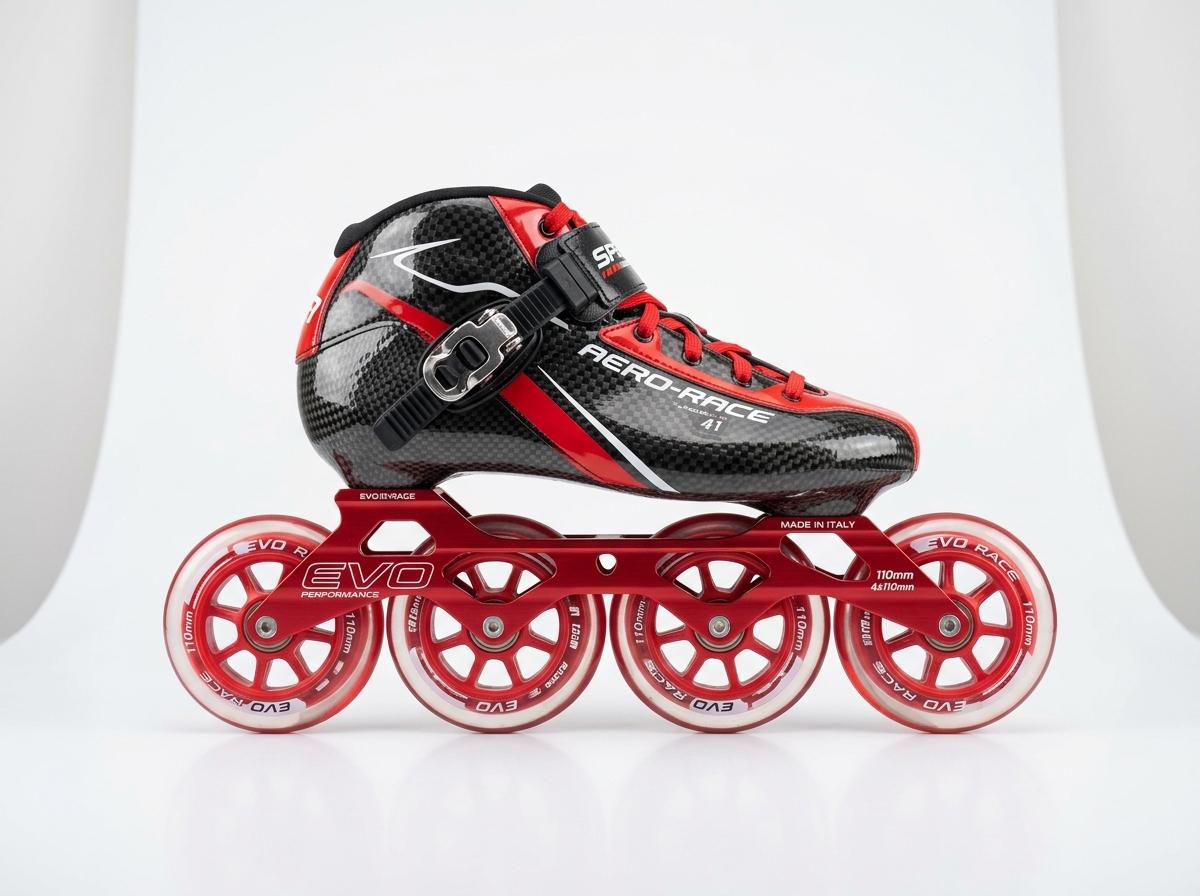
Unlike recreational or fitness rollerblades, an inline speed skate is composed of four modular components that can be independently customized, adjusted, and upgraded:
1. The Boot
Ultralight carbon or glass-fiber shell terminating just below the ankle bone to grant full pronation/supination range for the double-push stride.
2. The Frame (Chassis)
Extruded aircraft aluminum (6061-T6 or 7005 series) with lateral mounting slots. Holds 3 or 4 axles with zero torsional twist under sprint push.
3. The Wheels
High-rebound polyurethane tires poured onto rigid spoked cores. Sized strictly by age category (90mm, 100mm, 110mm, or 125mm).
4. The Bearings
Two 608-size precision bearings per wheel separated by an aluminum floating spacer, reducing frictional drag at 500+ RPM rotation.
Choosing the Right Boot: Support vs. Flexibility
Selecting the correct boot style depends directly on the skater's ankle strength and developmental tier:
Semi-Race / Medium-Cuff Boot
Features an ankle collar that extends 1–2 inches higher than a pure race boot, reinforced with a composite cuff and micro-ratchet buckle.
- Best For: Under 6, Under 8, and Under 10 beginners transitioning from quad or recreational skates.
- Advantage: Eliminates inward ankle collapse (pronation) while developing leg strength.
- Downside: Slightly heavier; limits extreme low-tuck cornering flex.
Low-Cut Carbon Fiber Boot
A stiff, low-profile carbon composite shell ending right beneath the malleolus (ankle bone) with zero ankle cuff.
- Best For: Competitive Under 12, Under 15, Under 18, and Senior athletes.
- Advantage: Unrestricted ankle articulation, maximum power transfer, thermo-moldable fit.
- Downside: Requires high intrinsic ankle tendon strength; blisters if sized loosely.
Never buy speed skates 2 sizes larger "to grow into"! A loose speed skate permits the heel to lift and the foot to slide laterally inside the shell, resulting in severe friction blisters, ankle pronation, and total loss of stride power. Buy exact foot size or a maximum of half a size up with heat-moldable padding.
Frame Selection: Length, Mounting Spacing & Geometry
The frame chassis directly dictates wheel base, maneuverability, and top-end straightaway stability. Official World Skate rules state that the overall frame length including wheels must not exceed 50 cm:
Short Frames (10.0" to 11.2" / 250mm–285mm)
Typically fitted with 165mm mount spacing to match smaller youth boot sizes (EU 31 to 36).
Performance: Sharper turning radius for tight 200m banked track corners; ideal for Cadet age brackets (Under 6 to Under 12) rolling on 90 mm wheels.
Long Frames (12.0" to 13.2" / 305mm–335mm)
Standard 195mm mount spacing for adult boots (EU 37 to 45). Accommodates 4×100mm, 4×110mm, or 3×125mm wheels.
Performance: Superior straight-line roll and road stability; absorbs high torque during 100m straight sprints and 42 km marathons.
Wheel Size Caps by Category & Durometer (Hardness)
Permissible inline wheel diameters are standardized under speed skating safety regulations to match athlete limb leverage and joint health:
| Age Category | Division Tier | Max Wheel Cap | Recommended Setup | Typical Durometer |
|---|---|---|---|---|
| Under 6 to Under 12 | Cadet (Ages ≤ 11) | Max 90 mm | 4×90mm or 3×90mm on 10.5" frame | 84A (Track grip) / 85A (Road) |
| Under 15 | Sub-Junior (Ages 12–14) | Max 100 mm | 4×100mm or 3×100mm + 1×90mm Hi-Lo | 85A–86A (Banked rink / road) |
| Under 18 | Junior (Ages 15–17) | Max 110 mm | 4×110mm standard race chassis | 86A–88A (High rebound speed) |
| Above 18 & Masters | Senior / Masters |
Max 110 mm 125 mm Marathon |
4×110mm (Track & Road) / 3×125mm (Marathon) | 86A (Track) / F1–F2 Dual Urethane |
Durometer Guide: 83A–84A provides superior grip on slick or unbanked concrete. 85A–86A is the national standard for smooth Vesmaco banked tracks. 88A+ offers maximum roll on hot outdoor asphalt road circuits.
Bearings: Precision, Tolerances & Maintenance
Every inline speed wheel houses two standard 608-size bearings (8 mm internal bore, 22 mm outer diameter, 7 mm width):
- ABEC-7 / ABEC-9 Chrome Steel: The industry standard for competitive youth skaters. Features chrome steel balls and self-lubricating nylon ball cages.
- Swiss Precision Bearings: Manufactured to tighter radial runout tolerances for smoother free-roll under cornering torque.
- Ceramic Bearings (Silicon Nitride Si3N4): Used by elite international racers. 60% lighter, impervious to rust, and resistant to frictional thermal expansion.
2026 Equipment Budget Guide (India)
Below is the realistic market investment landscape for competitive speed skate setups in India:
Competitive Beginner
Semi-race composite boot, 4×90mm extruded frame, ABEC-7 bearings.
- Under 6 to Under 10 racers
- High ankle stability
- Academy training ready
State-Level Racer
Low-cut carbon shell, CNC 6061 alloy frame, 100mm/110mm wheels, ABEC-9 bearings.
- Sub-Junior & Junior athletes
- Heat-moldable carbon shell
- Championship tournament compliant
National Level
Ultralight monocoque carbon boot, 7000-series alloy chassis, dual-durometer wheels.
- National medal contenders
- Sub-9.8s 100m drag capable
- Swiss precision bearings
Custom Pro Build
Full custom plaster-cast carbon boot, magnesium/composite chassis, ceramic bearings.
- World Skate & Asian Games
- Tailored anatomical foot mold
- Zero energy dissipation
Authorized Retailers & Anti-Counterfeit Checklist
- Purchase from verified Indian distributors and academy-recommended pro-shops (e.g. Cityrun, Simmons, Bont, PS Skates, Luigino/Atom).
- Avoid unbranded marketplace clones with soft plastic trucks or non-rebound toy wheels that flex under sprint loads.
- Ensure wheel print explicitly displays diameter and durometer (e.g.
100mm 85A) for call room marshal verification.
Ready to see how equipment performs on the track? Read our in-depth comparison on Rink vs Road Races or learn All About Speed Skating Progression.